
Nostalgia and Return
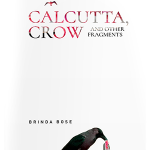
Nostalgia and Return: a brief account of Brinda Bose’s Calcutta, Crow and other fragments
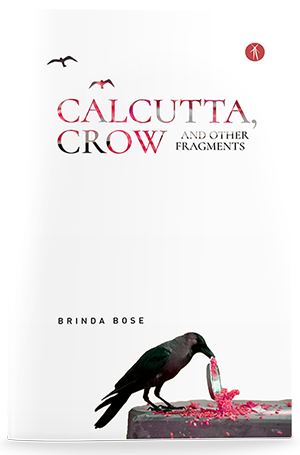
Calcutta Crow and other fragments by Brinda Bose is a telling book of poems, which reflects the melancholia of returning to one’s roots, especially when the arrival of death marks the return. In this chapbook, the reader finds glimpses of a gripping nostalgia that does not resemble popular notions; the private emotional spaces direct it, however.
Throughout the book, the reader will find several instances of striking imagery. The poet has blended into a morbid narration of a city that is home to several pages of history. For example, a plane ride in turbulent weather is drawn out with lines like “the promise of home darkling and sparkling / in a sepulchred sky / lurches into a jewelled breast flashing,” leaving the reader amused about the poet’s imaginative comparison of witnessing lightning and clouds from the inside of an airplane to a jeweled breast.
In “calcutta, crow III,” a walk down the College Street is immediately grasped by the reader when the poet writes, “finally only one street defines this city / the coffin of skeletal tramlines / where collegial ghosts rest.” Poetry, being the expression of a human being’s most subjective abstractions, is quite rare to come across lines like these. The abstract images drawn by Bose are transcended with stunning immediacy to the reader’s eyes.
In a city that is rapidly losing its old charm, this collection expresses the essence of its title, as it is filled with the fragments of the poet’s memory of grief, loss, distance, estrangement, and the city itself. The more one reads this book, immersing deep into the words of Brinda Bose, the image of a crow on every page of the book seems metaphorical because, in Bengal, the crow is the most common bird—a creature that ranges from petty commonness to plain ugly. But that is ever-present, much like the emotions of grief and sorrow, as expressed in this book.
Themes, which revolve around time and the contradiction of time being merciless and childish are a haunting occurrence in this book. The poem “loss” elicits the relationships a human can share with the inanimate objects and other human beings, ends with the lines: “a month is forever / and no time at all.”
At the end of the book, the reader may feel a longing for the past that never existed—like the literal meaning of nostalgia itself.
Browse Our Catalogue
- Bags2 products
- Bengali210 products
- Fiction46 products
- Journal2 products
- Memoir3 products
- Nonfiction59 products
- Poetry100 products
- English226 products
- Drama4 products
- Fiction31 products
- Journal3 products
- Literary Criticism9 products
- Memoir7 products
- Nonfiction24 products
- Poetry163 products
- Sanskrit1 product
Recent Posts
- WIVES
- The Poet is the Rosary

- On Collegiality and Other Ballads: feminist poems by male and non-binary allies, edited by Shamayita Sen
- Sanjeev Sethi’s HESITANCIES
- বিতান চক্রবর্তীর ‘ল্যান্ডমার্ক’
- A Scope of Enchantment to the Lonely
- Exploring the Devices of Poetry
- The Partition and the Agony
- Nostalgia and Return
- Media coverage of ‘Hibiscus’
Recent Comments
Be calm. Be still . Be silent, content. There’s a powerful resonance in these words. Looking forward to reading these…
As humanity burns in the flames of systemic injustice, Hibiscus blooms to heal our wounds, and to transform old sufferings…
After the book launch in the UK and the USA, it’s happening in India! So excited, and waiting to hold…
Simple and sincere and a good choice of poems. Well done!
I appreciate the simplicity of your reading choices. Morphie is a cute and charming poem with some irony. I think…
I have my copy (Ok, my husband may have bought a few more). After post-dinner chores are done I snuggle…
pleasure though in virtual reality. Best wishes. Wribhu Chattopadhyay
Simple and lovely! It’s great to see the books. I look forward to seeing my copy in the mail soon!
Dear Kiriti, I liked the way you recited the poems, making me feel the various hues on the Hibiscus, breaking…





I understand quite well and share Sudeep Sen’s profound desire to reveal himself. If the writer, any writer, cannot reveal…